
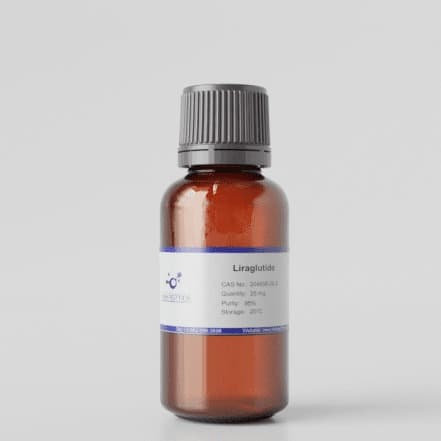
LiraglutideIn Stock
GLP-1 Agonists

Liraglutide

$245.00Was $285.00Save $40

A 26-amino acid GLP-1 analog fatty acid-acylated peptide used in metabolic research for studying long-acting GLP-1 receptor agonism and weight regulation.

Specifications

CAS Number
204656-20-2
Purity
>98% by HPLC
Form
Lyophilized powder
Storage
Lyophilized: -20°C. Reconstituted: 4°C, use within 14 days.
Solubility
Soluble in sterile water
Target
GLP-1 receptor (GLP1R); albumin-bound fatty acid acylation extends half-life to ~13 hours via FcRn-independent plasma protein binding; DPP-IV resistant
Sequence
His-Ala-Glu-Gly-Thr-Phe-Thr-Ser-Asp-Val-Ser-Ser-Tyr-Leu-Glu-Gln-Ala-Ala-Lys(Nε-C16 fatty acid via γ-Glu linker)-Glu-Phe-Ile-Ala-Trp-Leu-Val-Arg-Gly-Arg-OH (31 aa; [Arg34,Lys26(C16-FA)]GLP-1(7-37); 97% homology with human GLP-1)
Molecular Formula
C172H265N43O51
Molecular Weight
3751.2 g/mol

Quantity

1× $245.00 = $245.00
View CartCOA Soon

Research Overview

Clinical Research Context. Liraglutide is a GLP-1 receptor agonist that has been extensively studied for its effects on appetite regulation, blood sugar control, and body weight in clinical research. It is sold here strictly for laboratory and research purposes only.

Liraglutide is a 31-amino acid GLP-1 receptor agonist derived from GLP-1(7-37) incorporating two key structural modifications: replacement of Arg34 with Lys, and acylation of Lys26 via a γ-glutamic acid linker with a C16 palmitic acid chain. The fatty acid modification enables reversible non-covalent binding to human serum albumin, extending the circulating half-life to approximately 13 hours by protecting against glomerular filtration and DPP-IV-mediated proteolysis. Liraglutide retains 97% amino acid sequence identity with endogenous human GLP-1 and activates GLP1R with picomolar binding affinity, stimulating glucose-dependent insulin secretion, suppressing glucagon secretion, slowing gastric emptying, and reducing food intake via hypothalamic signaling. Research employing liraglutide has provided foundational insights into GLP-1 receptor signaling dynamics under prolonged receptor occupancy conditions. Mechanistic studies in primary rat and human pancreatic islets and beta-cell lines (INS-1E, MIN6-B1) have used liraglutide to characterize the temporal profile of GLP1R-cAMP signaling in secretory granule priming, exocytosis, and Ca²⁺ current potentiation. In vivo studies in high-fat diet-induced obese and db/db mice demonstrated that chronic liraglutide treatment preserves beta-cell mass by reducing glucolipotoxicity-induced apoptosis and promoting beta-cell proliferation through GLP1R-PKA-CREB activation of Pdx-1 transcription. Neurobiological research established that liraglutide achieves functional concentrations in the hypothalamus and brainstem, activating GLP1R on arcuate POMC neurons and NTS neurons to reduce food intake and body weight through anorexigenic circuits. Cardiovascular and neuroprotective research with liraglutide has been particularly impactful. The LEADER trial demonstrated a significant 13% reduction in MACE in high-risk cardiovascular patients, and subsequent mechanistic studies in atherosclerosis models revealed GLP1R-mediated suppression of endothelial inflammatory gene expression, foam cell formation, and VSMC proliferation. Neuroprotection studies using APP/PS1 Alzheimer mice, MPTP-induced Parkinson models, and TBI rodent paradigms demonstrated reductions in amyloid-β and tau pathology, neuroinflammation, and oxidative damage via GLP1R-mediated activation of PI3K/Akt/BDNF and autophagy pathways. These multisystem benefits have positioned liraglutide as a benchmark GLP-1 agonist for studying incretin pharmacology across metabolic, cardiovascular, and neurological research domains.

Research Use Only — Important Notice. For research use only. Not for human or veterinary use. Not intended for diagnostic or therapeutic purposes. Keep out of reach of children.

Research & Laboratory Use Only

All products on this site are sold strictly for research and laboratory use only. They are not intended for human consumption, diagnostic, or therapeutic purposes. Some compounds like Semaglutide and Tirzepatide are being studied in clinical settings for metabolic research and weight management, but any human use is outside the scope of this website and should only be done under medical supervision.