
 In Stock
Cosmetic Peptides
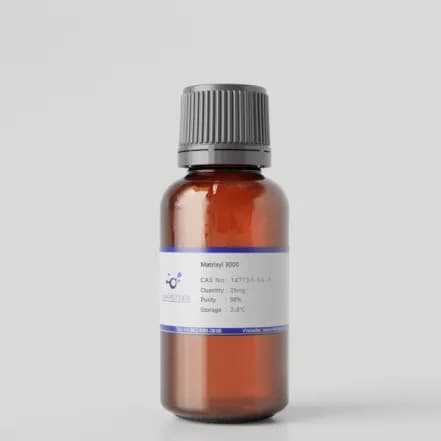
Matrixyl 3000
$158.00Was $198.00Save $40
A palmitoyl dipeptide-3 and matrikine signaling complex. Research focuses on collagen synthesis stimulation and ECM protein production.
Specifications
- CAS Number
- 221227-05-0
- Purity
- >98% by HPLC
- Form
- Lyophilized powder
- Storage
- Store at -20°C. Stable for 24 months when stored properly.
- Solubility
- Soluble in water
- Target
- Dermal fibroblasts; TGF-β and integrin signaling; collagen Types I and III synthesis
- Sequence
- Pal-GHK (Palmitoyl Tripeptide-1) + Pal-GQPR (Palmitoyl Tetrapeptide-7)
- Molecular Formula
- C34H62N8O7
- Molecular Weight
- 694.9 g/mol
Quantity
1× $158.00 = $158.00
View CartCOA Soon
Research Overview
Matrixyl 3000 is a patented matrikine complex developed by Sederma consisting of two palmitoylated oligopeptides: Palmitoyl Tripeptide-1 (Pal-GHK, derived from the C-terminal domain of type III collagen) and Palmitoyl Tetrapeptide-7 (Pal-GQPR, a fragment of the complement system protein C3). These peptides act as cell-communicating ingredients that mimic naturally occurring matrikines — extracellular matrix (ECM) fragments that signal fibroblasts to modulate collagen production and matrix remodeling.
The Pal-GHK component activates dermal fibroblasts through integrin-mediated receptor signaling, stimulating synthesis of collagen Types I and III, fibronectin, and glycosaminoglycans. The Pal-GQPR component inhibits the production of pro-inflammatory cytokines — including IL-6, IL-8, and TNF-α — that accelerate ECM degradation, thereby protecting newly synthesized collagen from enzymatic breakdown. The palmitic acid moiety on both peptides significantly enhances transdermal penetration and skin retention compared to non-palmitoylated sequences. In vitro studies demonstrate that Matrixyl 3000 stimulates collagen synthesis by up to 190% and fibronectin by up to 160% versus untreated controls.
Clinical research confirms that topical application reduces the depth and volume of facial wrinkles, improves skin elasticity and firmness, and restores dermal density in photo-aged and chronologically aged skin. The dual-peptide synergy of Pal-GHK and Pal-GQPR represents a comprehensive approach to ECM research, simultaneously promoting anabolic matrix synthesis and inhibiting catabolic inflammatory degradation pathways.
Research Use Only — Important Notice. For research use only. Not for human or veterinary use. Not intended for diagnostic or therapeutic purposes. Keep out of reach of children.
Research & Laboratory Use Only
All products on this site are sold strictly for research and laboratory use only. They are not intended for human consumption, diagnostic, or therapeutic purposes. Some compounds like Semaglutide and Tirzepatide are being studied in clinical settings for metabolic research and weight management, but any human use is outside the scope of this website and should only be done under medical supervision.