
 In Stock
Other Research Peptides
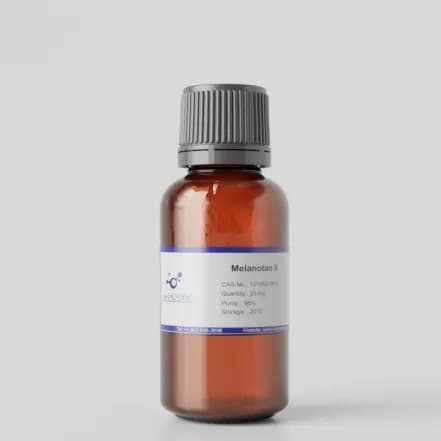
Melanotan II
$255.00Was $295.00Save $40
A synthetic alpha-MSH cyclic peptide analog used in research on melanocortin receptor pharmacology, tanning, sexual function, and appetite regulation.
Specifications
- CAS Number
- 121062-08-6
- Purity
- >98% by HPLC
- Form
- Lyophilized powder
- Storage
- Lyophilized: -20°C. Reconstituted: 4°C, use within 14 days.
- Solubility
- Soluble in sterile water
- Target
- Melanocortin receptors MC1R, MC3R, MC4R, MC5R; broad-spectrum agonist with enhanced potency and proteolytic resistance vs. linear α-MSH
- Sequence
- Ac-Nle-c[Asp-His-D-Phe-Arg-Trp-Lys]-NH₂ (cyclic heptapeptide; lactam-bridged α-MSH analog with Nle⁴ and D-Phe⁷ substitutions)
- Molecular Formula
- C50H69N15O9
- Molecular Weight
- 1024.2 g/mol
Quantity
1× $255.00 = $255.00
View CartCOA Soon
Research Overview
Melanotan II (MT-II) is a synthetic cyclic heptapeptide analog of α-melanocyte-stimulating hormone (α-MSH) incorporating key structural modifications: replacement of methionine in the HFRW pharmacophore with norleucine (Nle), substitution of L-phenylalanine with D-phenylalanine (D-Phe) for improved melanocortin receptor affinity, and formation of an N-terminally acetylated, C-terminally amidated lactam-cyclized backbone connecting the Asp and Lys side chains. These structural features produce a peptide with broad melanocortin receptor agonism (MC1R–MC5R) and markedly enhanced potency and proteolytic resistance compared to linear α-MSH. In research settings, MT-II is used as a pharmacological tool to activate the melanocortin system broadly, with binding affinities in the low nanomolar range for all five MCR subtypes, enabling investigation of pigmentation, sexual arousal, appetite suppression, and autonomic regulation.
Research employing Melanotan II in rodent models has extensively characterized its central actions on energy homeostasis and reproductive behavior. Intracerebroventricular and systemic MT-II administration in rats and mice produces dose-dependent reductions in food intake and body weight through hypothalamic MC4R activation in the paraventricular and dorsomedial nuclei, coupled with MC3R-mediated modulation of mesolimbic reward circuits. Sexual behavior studies using MT-II have defined the role of MC4R in the medial preoptic area (MPOA) and ventromedial hypothalamus (VMH) in mediating penile erection and lordosis behavior, respectively, establishing melanocortin signaling as a central regulator of copulatory function via dopaminergic and oxytocinergic intermediaries.
At the peripheral level, MT-II research has characterized MC1R-dependent melanogenesis in melanocyte cultures and skin explant models, demonstrating stimulation of tyrosinase, TYRP-1, and TYRP-2 expression and eumelanin biosynthesis via cAMP-CREB-MITF transcriptional cascades. Studies in MC5R-expressing exocrine gland models have examined MT-II's effects on sebum composition and lacrimal secretion, while MC3R pharmacology has been explored in adipocyte metabolism, inflammation, and sympathetic outflow studies. The broad receptor engagement of MT-II makes it a versatile reference agonist in comparative pharmacology assays for melanocortin receptor subtype selectivity profiling.
Research Use Only — Important Notice. For research use only. Not for human or veterinary use. Not intended for diagnostic or therapeutic purposes. Keep out of reach of children.
Research & Laboratory Use Only
All products on this site are sold strictly for research and laboratory use only. They are not intended for human consumption, diagnostic, or therapeutic purposes. Some compounds like Semaglutide and Tirzepatide are being studied in clinical settings for metabolic research and weight management, but any human use is outside the scope of this website and should only be done under medical supervision.