
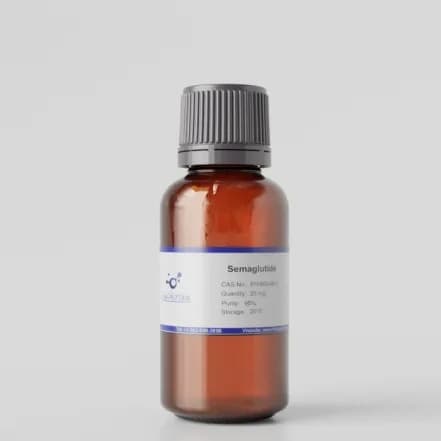
 In Stock
Semaglutide
A GLP-1 receptor agonist analog used in metabolic research. Studies glucose-dependent insulin secretion and body weight regulation pathways.
Specifications
- CAS Number
- 910463-68-2
- Purity
- >98% by HPLC
- Form
- Lyophilized powder
- Storage
- Lyophilized: -20°C. Reconstituted: 4°C, use within 28 days.
- Solubility
- Soluble in sterile water
- Target
- GLP-1 receptor (glucagon-like peptide-1 receptor)
- Sequence
- His-Aib-Glu-Gly-Thr-Phe-Thr-Ser-Asp-Val-Ser-Ser-Tyr-Leu-Glu-Gly-Gln-Ala-Ala-Lys-Glu-Phe-Ile-Ala-Trp-Leu-Val-Arg-Gly-Arg-NH2
- Molecular Formula
- C187H291N45O59
- Molecular Weight
- 4113.5 g/mol
Quantity
Research Overview
Clinical Research Context. Semaglutide is a GLP-1 receptor agonist that has been extensively studied for its effects on appetite regulation, blood sugar control, and body weight in clinical research. It is sold here strictly for laboratory and research purposes only.
Research Use Only — Important Notice. For research use only. Not for human or veterinary use. Not intended for diagnostic or therapeutic purposes. Keep out of reach of children.
Research & Laboratory Use Only
All products on this site are sold strictly for research and laboratory use only. They are not intended for human consumption, diagnostic, or therapeutic purposes. Some compounds like Semaglutide and Tirzepatide are being studied in clinical settings for metabolic research and weight management, but any human use is outside the scope of this website and should only be done under medical supervision.